
Introduction: A Grieving Community in the Wake of Tragedy
The Bavarian city of Aschaffenburg is reeling after a devastating knife attack that left two people dead, including a 2-year-old boy. The tragic incident, which took place on Wednesday, has sent shockwaves through the local community, prompting Mayor Jürgen Herzing to issue a powerful warning against escalating violence and hatred. As the attack stirs fresh debates on migration ahead of Germany’s upcoming elections on February 23, emotions are running high, and Herzing is urging calm amid the grief.
The Attack: A Tragic Loss
The stabbing occurred in the southern German city of Aschaffenburg, leaving two victims dead and several others seriously injured. Authorities have taken a 28-year-old Afghan man into custody in connection with the attack. The suspect, who has a history of violent behavior and was receiving psychiatric treatment, had reportedly said in December that he planned to leave Germany but stayed in the country while continuing to seek medical care.
While the details of the attack are still unfolding, the city is in shock. At a wreath-laying ceremony on Thursday, Mayor Herzing described himself as “shaken up” by the tragic events, highlighting how the attack has amplified a tense national conversation about migration and immigration policy in Germany.
The Mayor’s Response: A Call for Unity and Calm
During the wreath-laying service, Herzing made a passionate appeal to the community to resist hatred and revenge, emphasizing that the actions of one individual should not reflect on an entire group of people. “We can and must never attribute the act of one individual to an entire population group,” he said, stressing the importance of distinguishing between the actions of an individual and the broader community.
He also expressed his deep emotional connection to the victims, stating, “I feel as if my own child had died—or my brother had died or been injured.” Herzing’s empathy for the victims and their families resonated deeply with local residents, many of whom are struggling with grief and anger.
Parallels with Previous Attacks: A Lingering Concern
Herzing pointed out that there are troubling parallels between the recent Aschaffenburg stabbing and other violent incidents involving migrants in Germany. He referenced previous attacks in Magdeburg, Solingen, and Würzburg, where innocent lives were taken by individuals with migrant backgrounds. These attacks have often stoked fears and divisions around migration in Germany.
The mayor’s remarks underscore the tension in the country, where each incident fuels broader debates about the challenges of integrating migrants and the risks of radicalization. However, Herzing was careful to avoid blanket condemnation of any one community, acknowledging that the perpetrator was an individual with his own history of mental health struggles.
A Message of Unity from Aschaffenburg’s Muslim Community
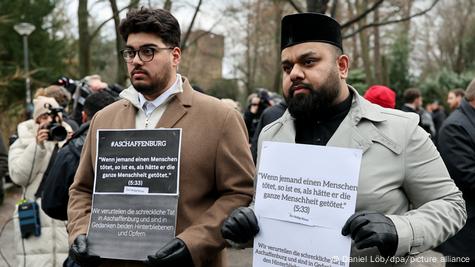
In a poignant gesture of solidarity, leaders from the local Muslim community in Aschaffenburg attended the wreath-laying ceremony, holding signs with a verse from the Quran: “When someone takes a life, it will be as if they killed all of humanity.” Their presence highlighted the importance of standing together in the face of tragedy, with faith leaders and residents alike calling for healing and unity.
Imam Zischan Mehmood, a key figure in Aschaffenburg’s Islamic community, also spoke out against the actions of the individual suspect, distancing the broader Muslim community from the violence. He joined in Herzing’s call for a balanced and compassionate response to the tragedy.
The Bigger Picture: Migration and Violence in Germany
The tragic events in Aschaffenburg have reignited the ongoing debate in Germany over the challenges of migration and integration. As elections approach, political leaders are under pressure to address growing concerns about crime and public safety linked to migrant communities. However, as Herzing and local religious leaders have pointed out, focusing on the actions of one person can perpetuate harmful stereotypes and escalate divisions within society.
The recent violence adds to a broader pattern of public discourse in Europe surrounding the integration of migrants and refugees, with many questioning how to balance national security with humanitarian efforts. This debate, however, should not cloud the importance of upholding values of unity and compassion, even in the wake of deep loss.
Looking Ahead: A Path Toward Healing
As Aschaffenburg mourns its losses, the community faces the difficult task of moving forward. The attack may have left a lasting scar on the city, but leaders like Mayor Herzing are working hard to ensure that the town remains a place of solidarity rather than division.
Despite the grief and anger, Herzing remains committed to guiding his community toward healing, focusing on what unites rather than divides people. “We must not let this spiral of violence and hatred take hold,” he said. “In the face of this tragedy, we must remain strong together.”
The city is now preparing for a funeral service on Sunday to honor the victims and offer comfort to those who have been affected by the attack. As the investigation into the suspect continues, Aschaffenburg is determined to rise above the tragedy and prevent further division.
Conclusion: A Community Tested but Not Broken
The tragic stabbing in Aschaffenburg serves as a stark reminder of the challenges facing Germany in terms of migration, integration, and public safety. But Mayor Jürgen Herzing’s call for calm, unity, and compassion provides a much-needed contrast to the rising rhetoric of division and hatred. As the community continues to grieve, it is clear that the road ahead will require empathy, understanding, and a collective effort to move beyond the violence and hatred that can so easily take root.