
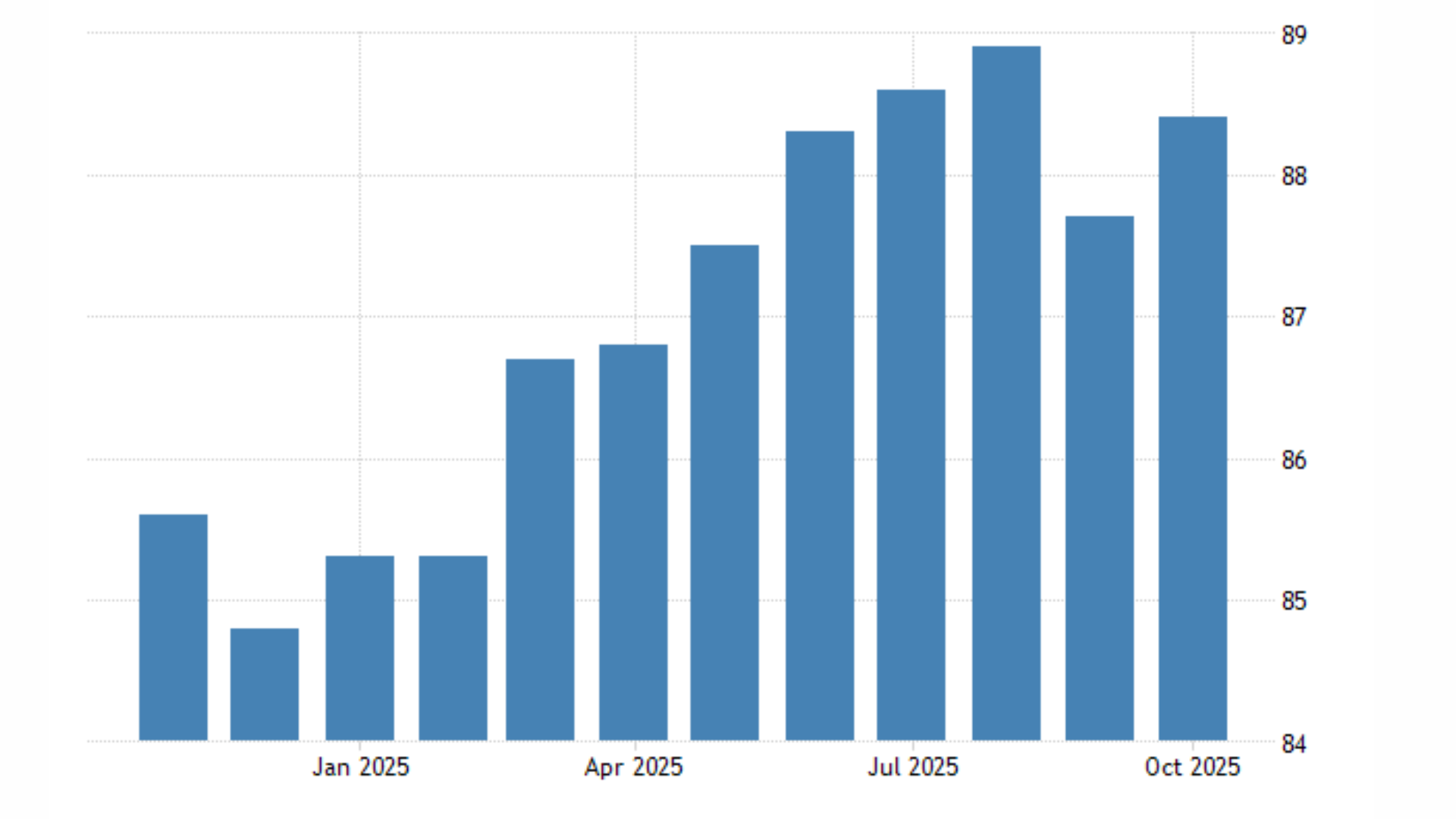

Germany’s corporate leaders are growing increasingly cautious about the nation’s economic outlook, according to a new KPMG survey that shows a notable decline in confidence among top executives. The findings indicate that only 72% of German CEOs expect their companies to grow over the next three years — a steady drop from 77% in 2024, 80% in 2023, and a high of 90% in 2022.
The report, conducted by surveying dozens of executives from industries such as manufacturing, autos, and finance, captures a snapshot of strategic prudence supplanting previous optimism. Germany’s sluggish industrial production, chronic inflation, and geopolitical risks are collectively undermining business sentiment within what was previously Europe’s economic powerhouse.
Waning Confidence in the Global Outlook
One of the most dramatic data points in the survey is plummeting confidence in the world economy. Just 64% of German CEOs are optimistic about the larger international economic setting — down from 69% last year. Most leaders named China’s slowing growth, increasing energy prices, and continued supply chain disruptions as significant barriers to recovery.
“Each of the past two years has pushed every resilience and predictability assumption we had to the limit,” remarked one CEO from Germany’s automotive industry who took part in the survey. “The new norm is volatility, and our strategies now need to be constructed on the back of agility instead of growth.”
Germany’s export-dependent economy has been especially exposed to swings in world trade. Softening demand for machinery and manufacturing products, together with costly energy after the war in Ukraine, have tightened margins even for some of the nation’s strongest makers.
A Shift in Strategic Priorities
To counter the increasing pressures, most German CEOs are shifting focus from expansionary aggression to operational effectiveness. The survey reflects that cost optimisation, digitalisation, and supply chain robustness now occupy the top spot among strategic priorities.
Approximately 68% of the executives indicated that they are restructuring business models to keep up with slower growth conditions and are doing so actively. Automation and AI are central to these initiatives as firms try to counteract labor shortages while still increasing productivity.
The German industry transformation is real and immediate,” Dr. Matthias Schmelzer, KPMG Germany partner, stated. “Leaders are not anymore concentrating exclusively on size or top-line growth — they are concentrating on flexibility, technology assimilation, and risk avoidance.
This practical response mirrors a wider European tendency. With other large economies such as France and Italy also experiencing industrial slowdowns, enterprise leaders throughout the continent are reassessing conventional models of stability and long-term thinking.
Geopolitical and Policy Pressures
The survey also flags the influence of geopolitical unpredictability on CEO opinion. Western tension with China, conflict in Eastern Europe, and evolving global trade alliances have contributed to a perception of uncertainty.
For German exporters, particularly those engaged with the automotive and engineering sectors, dependencies on Chinese trade continue as a source of concern. Recent EU deliberations regarding new tariffs and trade restrictions have served only to heighten fears.
At the national level, CEOs have complained about bureaucratic roadblocks and energy policy holdups. Most feel Germany’s shift to renewables, as vital as it is, has not been followed by adequate infrastructure investment or budget incentives to spur industry transformation.
“The policy climate is too reactive, not visionary,” replied an energy sector CEO. “Berlin must provide quicker decision-making to allow German industry to remain competitive.”
Leadership in a Time of Uncertainty
While sentiment has definitely worsened, pundits warn that the data must not be read as pure pessimism. Rather, CEOs are repositioning expectations — distancing themselves from high-growth projections and embracing more balanced, sustainability-oriented models.
Notably, more than 80% of CEOs polled indicated they are still convinced about long-term investments in digitalization, clean energy, and technology. This implies that although short-term confidence is rattled, German business leadership remains wagering on change as the secret to survival and rebirth.
These CEOs also find opportunity in crisis. As global supply chains break apart, some companies are testing “friend-shoring” strategies — shifting some of their production to such countries as India, Poland, and Vietnam to minimize dependence on a single market.
The Road Ahead
It is evident from the latest KPMG reports: Germany’s business sector is embarking on a time of guarded pragmatism. The previously irrepressible confidence of its top executives is increasingly being replaced by a more realistic recognition of structural issues — from demographic shrinkage to decoupling between the world.
Yet the same resilience that forged Germany’s post-war economic miracle can again shape its destiny. With a focus on innovation, sustainability, and strategic alliances, German CEOs are gearing up to navigate a complicated world with measured discipline instead of blind optimism.
As one manufacturing chief explained: “The mood might be hesitant, but the mission remains the same — to keep Germany competitive, innovative, and irreplaceable on the global stage.”

