
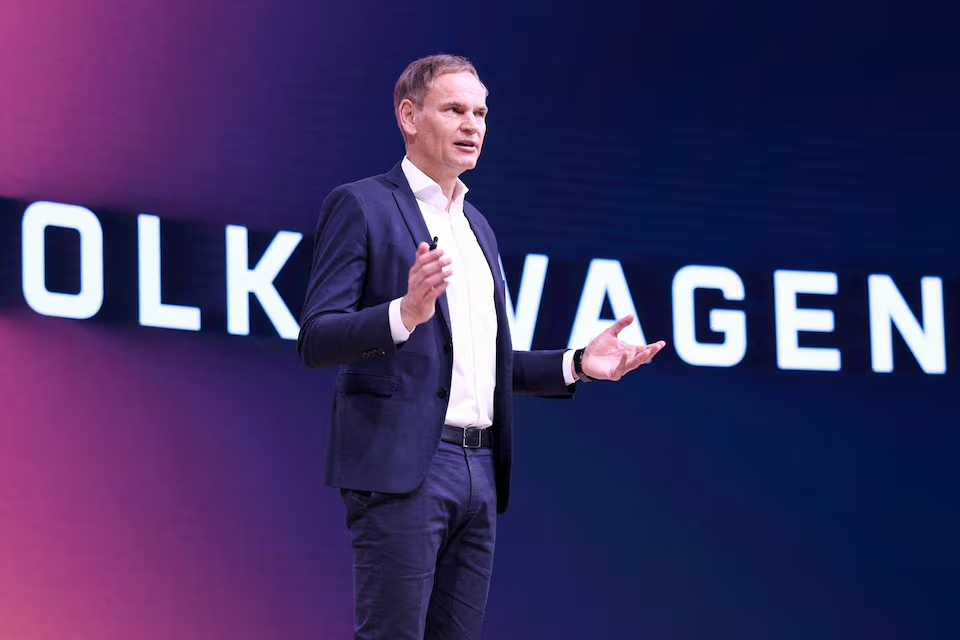

Europe’s leading carmaker, Volkswagen, finds itself in the limelight once more—not over its vehicles but over its leadership arrangement. In an internal letter, Volkswagen’s influential labor representatives recently called on Oliver Blume, the company’s CEO, to move aside from his concurrent posts as CEO of both Volkswagen AG and Porsche AG. The message is unambiguous: Managing two global behemoths simultaneously is not just unsustainable but potentially harmful to both brands in the long term.
A Dual Role Under Fire
Oliver Blume has played two roles since 2022, when he took over Volkswagen AG’s leadership while continuing to be the head of Porsche AG. At the time, the decision was presented as a bridge of leadership continuity amid a transition phase. Porsche had recently floated its successful IPO, and Volkswagen was struggling with strategic moves in electrification, software, and worldwide expansion.
But increasingly, questions have become loud. Can a single leader fully apply enough time and energy to guiding both companies through difficult industry challenges? Labor leader Daniela Cavallo, in her letter, appears to think not. She makes the case that Volkswagen needs top, unvarnished attention to get through competitive threats from Tesla, Chinese electric vehicle manufacturers, and tightening regulations worldwide.
Why Volkswagen Workers Are Concerned
Volkswagen’s works council, representing thousands of workers in Germany and around the world, holds a singularly powerful position in Volkswagen’s governance. In their opinion, Blume’s two hats threaten to hobble decision-making at a time when speed and unity are essential. As Volkswagen is now in the middle of ambitious restructuring efforts, employees want to be sure that their future is not jeopardized by split focus from the leadership.
The council has also highlighted possible conflicts of interest between the two firms. While Porsche has a degree of autonomy following its listing on the stock market, it is still closely linked with Volkswagen via technology sharing, brand positioning, and joint resources. A dual chief executive role is criticized for blurring accountability at a time when clarity is being demanded by shareholders and employees alike.
Blume’s Balancing Act
Blume has defended his ability to balance both posts, citing his record at Porsche, where he guided the brand through a time of record profitability and the rollout of its first entirely electric vehicle, the Taycan. He has also been outspoken about his vision for Volkswagen’s move into electrification and digital services.
But even his critics admit the unprecedented challenges of managing two giant carmakers at once. Volkswagen AG itself is a huge empire with more than 600,000 workers, 10 passenger car marques, and presences in virtually every large market. Porsche, while smaller, is one of the globe’s most valuable luxury car groups and needs steady hands as it builds out its electric lineup.
Industry Trends Favor Focused Leadership
The demand that Blume resign from one of his positions is indicative of wider corporate governance trends. Over the past few years, big multinationals have tended away from dual leadership and towards greater stresses on single accountability at the helm. Investors also tend to want a solid chain of command, especially where the industry is going through disruption.
For Volkswagen, the stakes are particularly high. It needs to speed up its transition to electric cars amidst supply chain risks, regulatory forces, and increased competition from China. For Porsche, the risk is equally high, with buyers demanding the latest technology without sacrificing the luxury and performance that it is famous for.
What Happens Next
While the memo is a powerful assertion on the part of labor, it does not necessarily dictate outcomes. Volkswagen’s supervisory board, which consists of members representing the Porsche–Piëch family, the Lower Saxony state, and employee groups, will make the final decision on whether Blume remains in both positions.
Speculation has already begun about potential successors at Porsche should Blume step down there. Industry insiders suggest that a transition could be completed by early 2026, giving both companies time to plan for a smooth handover.
For the time being, Blume still sits atop both Volkswagen and Porsche. But with growing pressure from within his own company, the double CEO experiment is looking decidedly precarious. The next several months will show if Volkswagen decides to stick with continuity or go for more pointed, more targeted leadership.
A Moment of Decision
The controversy is bigger than an issue of names. It is a challenge of how Volkswagen weighs tradition, innovation, and leadership in an era of fundamental industry transformation. For workers, investors, and consumers alike, the result may determine the course of two of the world’s most legendary automobile brand names.

