Meet Friedrich Merz: The New Conservative Leader Set to Replace Olaf Scholz as German Chancellor

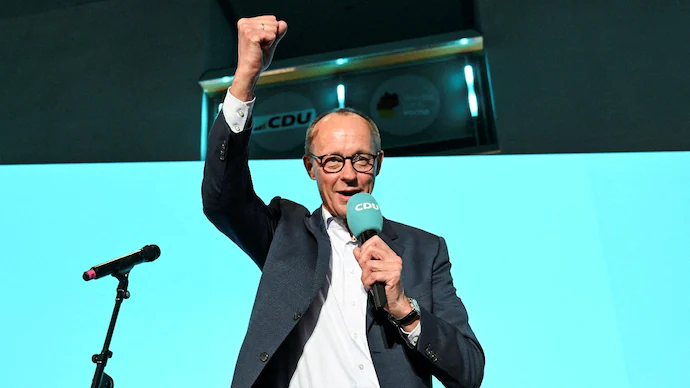
Germany is set to witness a major shift in its political landscape as Friedrich Merz, leader of the Christian Democratic Union (CDU), has emerged as the frontrunner to replace current Chancellor Olaf Scholz. After winning big in the 2025 German elections, Merz is ready to take the helm. But who exactly is Friedrich Merz, and how did he rise to power? Let’s dive into the life, career, and future plans of the man poised to lead Germany.
Friedrich Merz: From Corporate Lawyer to Chancellor Aspirant
Friedrich Merz is not your typical politician. A highly educated corporate lawyer, Merz’s career has spanned several fields, including law, business, and politics. Born in Brilon, Germany, in 1955, Merz was raised in a family steeped in legal tradition—his father was a judge and a member of the CDU, the very political party Merz would later lead.
Before embarking on his political journey, Merz was a soldier in the German Army and a judge. After earning his law degree in the mid-1980s, he worked as a lawyer for a German industry association before fully immersing himself in the world of politics.
Merz’s Political Rise and Setbacks
Merz joined the Christian Democratic Union (CDU) in 1972 and quickly made a name for himself within the party. By 1989, he became a member of the European Parliament. In 1994, he entered the Bundestag (Germany’s federal parliament), where he would hold several key positions, eventually becoming the CDU’s parliamentary leader in 2000.
However, his political rise came to an abrupt halt in 2009 when he was forced out of politics following internal party struggles, most notably with Angela Merkel, the long-serving CDU Chancellor of Germany. For nearly a decade, Merz remained on the sidelines, working as a corporate lawyer and heading the Atlantik-Brücke, a lobby group that promotes transatlantic relations.
Return to Politics: Merz’s Comeback
Merz’s return to politics was in 2018 when Angela Merkel stepped down as CDU leader. His bid to succeed her was unsuccessful, as he lost narrowly to Annegret Kramp-Karrenbauer. Two years later, Merz wasn’t considered for the role of CDU leader again when the party chose Armin Laschet.
But Merz didn’t give up. His persistence paid off in 2022 when the CDU elected him as the party chairman on his third attempt. This victory was pivotal. After 16 years under Merkel’s leadership, the CDU was looking for reinvention, and Merz’s conservative values seemed to resonate with the party’s base. His win also came at a critical time after the CDU’s poor performance in the 2021 election.
Friedrich Merz’s Rise to Chancellor
In the September 2024 election, Merz and his CDU/CSU alliance triumphed with approximately 28.5% to 29% of the vote, defeating Olaf Scholz’s Social Democratic Party (SPD). This victory marked a significant turning point for Merz, as he was now in the position to become Germany’s next Chancellor.
Merz wasted no time in calling for the formation of a new government, emphasizing the need for swift action. “The world out there is not waiting for us,” he said, highlighting the urgency of tackling Germany’s political and economic challenges.
The 2025 Election Results: What Led to Merz’s Victory?
The 2025 general election results reflected a dramatic shift in Germany’s political landscape. Merz’s CDU/CSU alliance topped the polls, securing 28.5-29% of the votes. The far-right Alternative for Germany (AfD), which has gained traction in recent years, came second with 19.5-20% of the votes. Meanwhile, Scholz’s SPD, which has traditionally been a major player in German politics, suffered its worst-ever result, winning only 16-16.5% of the vote.
Other parties, such as the Greens (12-13.5%) and the far-left Die Linke (8.5-9%), also performed reasonably well, but they weren’t able to match Merz’s strong showing.
What Does Friedrich Merz’s Leadership Mean for Germany?
With Merz set to become Chancellor, Germany is bracing for a shift to a more conservative government. Merz has been a vocal critic of Olaf Scholz’s policies and is expected to focus on strengthening Germany’s economy, reducing taxes, and limiting immigration. Additionally, his leadership might steer Germany in a more market-driven direction, with a focus on bolstering industry and ensuring Germany remains competitive on the global stage.
Merz’s alliance with the Christian Social Union (CSU) in Bavaria further solidifies the conservative nature of his leadership. The CSU’s influence on German politics means Merz is likely to pursue policies that reflect traditional values and prioritize the interests of conservative voters.
However, the success of Merz’s leadership will depend on his ability to form stable coalitions with other parties, particularly given the presence of far-right groups like the AfD. While Merz has expressed a commitment to quick government formation, navigating a coalition with smaller parties could prove to be a challenging task.
Friedrich Merz’s Vision for Germany’s Future
As Germany’s new leader, Friedrich Merz will have to address key issues facing the country. From economic reforms to climate change, Merz’s agenda is expected to cover a broad range of topics. One of his central goals will be to foster economic growth, revitalize Germany’s manufacturing sector, and streamline the country’s labor market.
Merz is also likely to focus on reducing Germany’s dependency on foreign energy sources, particularly from Russia. His leadership could bring about a more self-sufficient Germany, with an emphasis on bolstering green technologies and creating jobs in the renewable energy sector.
The Opposition: What’s Next for Olaf Scholz and the SPD?
Olaf Scholz and his Social Democratic Party (SPD) are now at a crossroads. After a disappointing election result, Scholz acknowledged that the SPD’s performance was poor and took responsibility for the outcome. With Merz’s CDU/CSU taking the lead, the SPD will need to rethink its strategy moving forward.
While the SPD is expected to remain a significant force in German politics, Scholz’s tenure as Chancellor is likely coming to an end. The SPD may focus on rebuilding its platform to appeal to younger voters and addressing concerns such as income inequality and social justice.
Conclusion: What Lies Ahead for Germany?
As Friedrich Merz prepares to take over as Germany’s next Chancellor, the country stands on the cusp of change. With his background in law and business, Merz is poised to bring a fresh perspective to German politics. His rise marks the end of Olaf Scholz’s tenure and signals a shift towards a more conservative government.
The next few years will be crucial for Germany’s future as Merz navigates a changing political landscape, global economic challenges, and an increasingly diverse electorate. His leadership could shape Germany’s political and economic trajectory for years to come.