
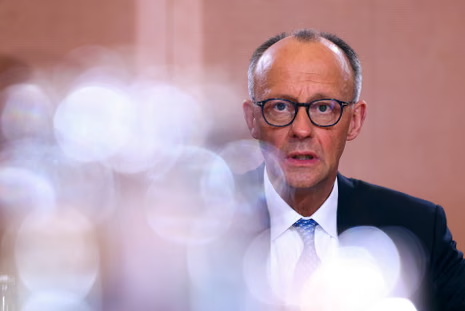

German Chancellor Friedrich Merz has announced plans to broaden Germany’s trade diplomacy by engaging with countries outside the traditional transatlantic sphere. Speaking to the Bundestag on Wednesday, Merz said he intends to visit key international partners in the coming weeks and months to strengthen economic ties and discuss opportunities for trade expansion.
Merz’s statement underscores Germany’s commitment to diversifying its trade relationships, particularly at a time when global supply chains are evolving and economic uncertainties persist. While Germany has historically relied heavily on trade with the European Union, the United States, and other Western allies, the Chancellor emphasized the importance of reaching beyond these familiar partners to explore new markets and investment opportunities.
A Shift in Germany’s Trade Focus
Germany, as Europe’s largest economy and a leading exporter, depends on a robust network of international trade partners. Traditionally, a significant share of German exports has been destined for EU countries and the United States, covering sectors such as automobiles, machinery, chemicals, and industrial equipment. However, recent shifts in global economic power and changing geopolitical dynamics have prompted the German government to seek diversification.
“While transatlantic relations remain vital, Germany must also strengthen ties with partners across Asia, Africa, and Latin America,” Merz told lawmakers. “Engaging with emerging markets will not only benefit our exporters but also ensure Germany remains competitive in a rapidly changing global economy.”
Economic analysts view this approach as a strategic move to reduce reliance on traditional markets that may face slower growth or political uncertainty. Countries in Southeast Asia, Africa, and Latin America represent significant opportunities for German companies, particularly in sectors such as renewable energy, infrastructure, digital technology, and advanced manufacturing.
Strengthening Global Partnerships
Merz did not provide a detailed itinerary during his Bundestag address but suggested that his visits would target countries with complementary economic interests. Germany has been active in strengthening trade relationships with nations like India, Vietnam, Brazil, and South Africa, and these regions are expected to feature prominently in the Chancellor’s outreach.
The aim of these visits, according to Merz, is to facilitate dialogue on trade agreements, investment partnerships, and regulatory cooperation. By establishing closer ties with emerging economies, Germany hopes to secure long-term export opportunities, support domestic industries, and create jobs.
Implications for German Industry
For German businesses, the Chancellor’s initiative could open doors to new markets and partnerships. Exporters of automobiles, industrial machinery, and chemical products may benefit from reduced trade barriers and improved bilateral agreements. Similarly, sectors such as renewable energy technology, digital services, and fintech could see enhanced collaboration with governments and private enterprises abroad.
Industry groups in Germany have largely welcomed the announcement. The Federation of German Industries (BDI) noted that expanding trade relations beyond traditional partners is critical for long-term economic stability. “Germany must remain proactive in exploring new markets,” a BDI spokesperson said. “Global diversification strengthens our competitiveness and supports sustainable growth for businesses and workers alike.”
Balancing Global Engagement with Domestic Priorities
While international trade expansion is a key priority, Merz also acknowledged the importance of balancing foreign engagement with domestic economic concerns. He stressed that trade visits would be designed to benefit German workers and industries, ensuring that agreements translate into tangible economic outcomes at home.
“Every international partnership must serve the interests of our citizens,” Merz said. “Trade is not an abstract concept—it has real impacts on jobs, wages, and innovation in Germany. Our goal is to ensure that German expertise, products, and services reach new markets while supporting growth at home.”
The Chancellor also highlighted the importance of sustainable and responsible trade practices. As Germany seeks to expand its global footprint, issues such as environmental standards, labor rights, and fair competition will be central to negotiations. By emphasizing ethical trade, Merz hopes to project Germany as a reliable partner in an increasingly interconnected global economy.
Geopolitical Considerations
Merz’s outreach comes at a time of significant geopolitical flux. Rising tensions between major powers, supply chain disruptions, and shifting alliances have made trade diversification a strategic imperative. By engaging with countries outside the traditional transatlantic network, Germany aims to hedge against risks and maintain resilience in its export-driven economy.
Experts suggest that these visits could also strengthen Germany’s position in global trade negotiations, including at the World Trade Organization and other multilateral forums. By demonstrating active engagement with a broader set of partners, Germany can help shape international trade rules while promoting its own economic interests.
Looking Ahead
Germany’s next few months will be closely watched by both domestic and international stakeholders. Successful engagement with new trade partners could lead to agreements on investment, technology exchange, and regulatory harmonization. Conversely, failure to navigate complex diplomatic and economic landscapes could limit the potential benefits.
For now, Merz’s announcement signals a proactive approach to global economic challenges. By seeking opportunities beyond traditional markets, Germany aims to maintain its status as a leading exporter, support domestic industries, and strengthen long-term international partnerships.
As the world economy continues to evolve, the Chancellor’s strategy highlights the importance of adaptability, foresight, and engagement in securing Germany’s economic future. The coming months of trade diplomacy will be crucial in determining whether Germany can capitalize on emerging opportunities and navigate the complexities of a rapidly changing global marketplace.