
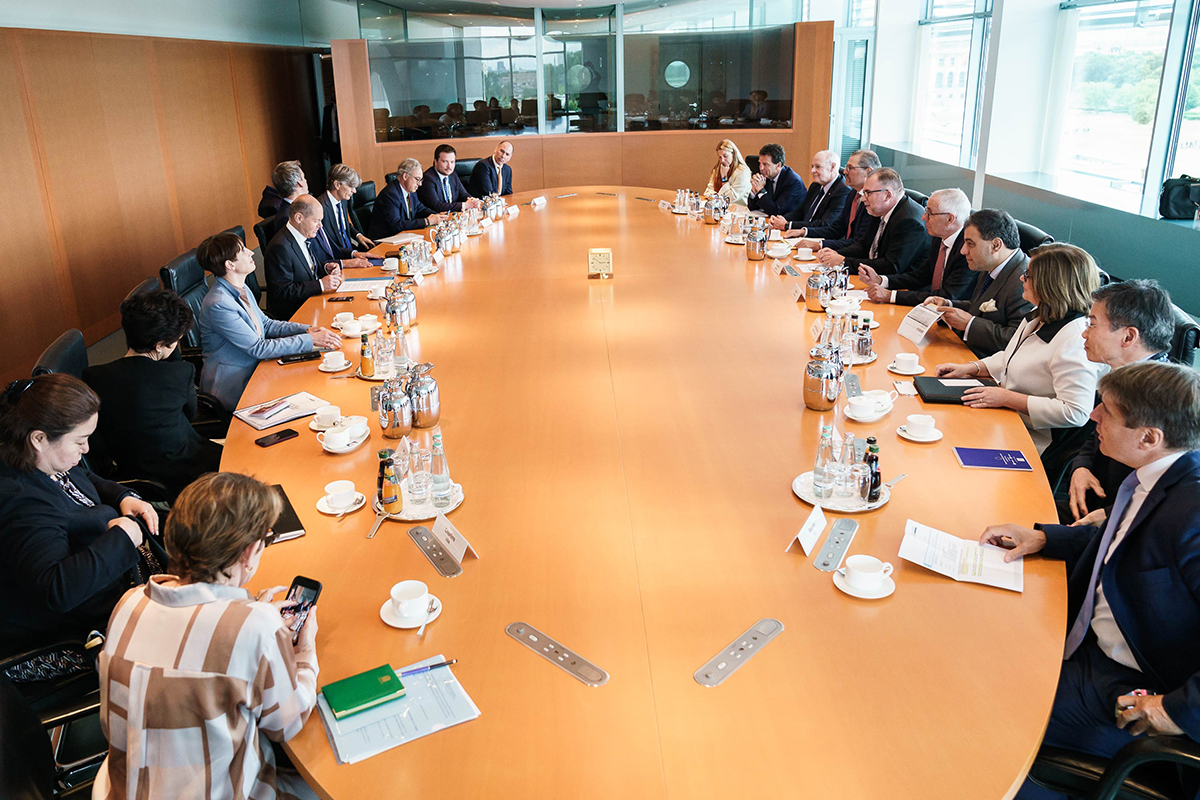

The mood is darkening in Germany’s corporate boardrooms as economic headwinds and the global uncertainties weigh heavily on the outlook of the country’s top executives. In the most recent CEO confidence survey, optimism among German business leaders has fallen for a third year in a row, reflecting growing concerns over sluggish domestic demand, increased regulatory pressure, and geopolitical instability.
Only 72% of German CEOs surveyed expect their companies to grow over the next three years, a number that has been trending down from 77% in 2024, 80% in 2023, and 90% in 2022. The decline reflects an increasing skepticism about Germany’s ability to maintain its industrial competitiveness in light of soaring energy costs, a very slow digital transformation, and a weakening export market.
Mounting Challenges for Europe’s Largest Economy
The economy of Germany, once Europe’s powerhouse, has struggled to regain momentum since the pandemic. A mix of high energy prices, shrinking industrial output, and tight monetary policy has eroded confidence among businesses. Many CEOs say their biggest worries stem from stagnant productivity growth, labor shortages, and bureaucratic red tape that continues to slow innovation.
The war in Ukraine and ongoing disruptions to global supply chains have further complicated the manufacturing-led economy of Germany. With China-one of Germany’s most vital export markets-faces its own slowdown, German industrial giants like BASF, Volkswagen, and Siemens reconsider their strategies globally. The country, dependent on exports and manufacturing, has been more exposed than others to the fluctuations in global demand and geopolitical instability.
“German businesses operate in a new reality,” said a leading analyst with the German Economic Institute. “The recovery after the pandemic was to be strong, but high inflation, weak domestic consumption, and policy uncertainty-these all make for an environment in which optimism is rapidly fading.”
Declining Confidence in Global Growth
Beyond domestic concerns, German CEOs are also growing less confident in the global economy. Only 64% of the executives said they believe global conditions will improve over the next three years, down from 69% in 2024. The drop reflects fears of a fragmented world economy, with countries putting a larger focus on local industries and instituting greater controls on trade.
Moreover, the protectionist policies of recent times, especially in the U.S. and partially in Europe, have created further hurdles for exporters in Germany. Meanwhile, the European Union’s push toward green transformation — though widely supported — requires massive investments that not all companies are able to make in the short run.
Notably, executives expressed frustration also at the pace of improvement in Germany’s digital infrastructure. An innovation hub in engineering and manufacturing, the country lags well behind in areas such as artificial intelligence adoption, 5G connectivity, and scaling startups.
Shifting Priorities for Corporate Leadership
The changing economic environment is forcing CEOs to reassess their strategy. More and more companies are developing business models that focus on cost optimization, sustainable growth, and regional diversification. Many businesses have already started shifting away from the high levels of exports and toward strengthening domestic supply chains and investing in Europe’s internal markets.
Leadership, too, is changing. CEOs are becoming more cautious: focusing on risk management and resilience, rather than rapid expansion. There’s a noticeable shift toward digital efficiency-automation, data-driven decision-making, and AI-powered operations-as businesses look for ways to stay profitable in a world of uncertainty.
Margherita Della Valle, chief executive of Vodafone Group, recently pointed out that success in Europe increasingly depends on operational discipline and adaptability. “We must lead with resilience and reform,” she said, emphasizing how European companies, including those in Germany, need to modernize their business models to stay competitive.
Lessons from the Fall in Confidence
The drop in CEO confidence is a telling sign of where the German economy might be headed. Economists still anticipate modest growth, and experts say its core fundamentals — industrial base, tech sophistication, and skilled labor — remain solid. However, for confidence to rebound, policymakers will have to act resolutely toward simplifying regulations, actively investing in innovation, and accelerating the green and digital transitions. To the leaders of corporate enterprises, the message could not be louder: Adaptation is no longer optional. The economic environment is changing more rapidly than it ever has; CEOs must transform from the front, while balancing short-term cost challenges with long-term strategic investments. As the global landscape now becomes increasingly complex, the resilience of German CEOs will be key to seeing how well Europe’s largest economy navigates its next chapter. For now, the mood may be subdued, but the years ahead will test whether German leadership can turn caution into renewed confidence.

