
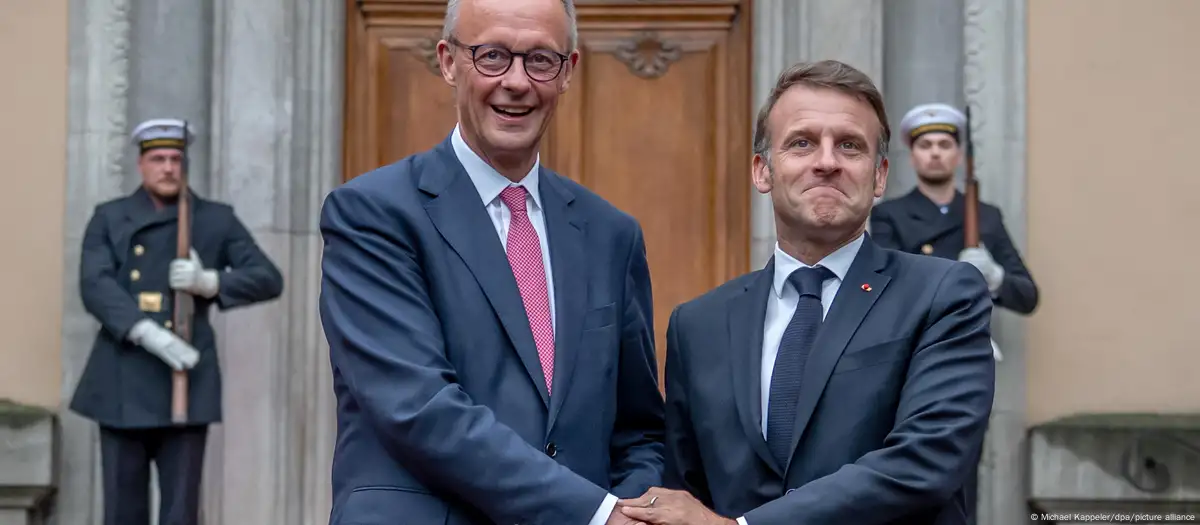

As tensions simmer between the European Union and the United States over trade, German Chancellor Friedrich Merz and French President Emmanuel Macron put on a display of unity in Berlin this week, signaling renewed Franco-German resolve to tackle Europe’s mounting geopolitical and economic challenges together.
The meeting, held at the historic lakeside Villa Borsig just outside the German capital, marked Macron’s first visit to Berlin since Merz’s center-right government took office in early May. Over an evening of diplomatic dialogue and shared vision, the two leaders reaffirmed their commitment to deepening bilateral ties and working closely on the European stage.
A Strategic Show of Solidarity
“We stand on the foundation of a close Franco-German friendship that has developed over decades,” said Chancellor Merz as he welcomed Macron. “And we both feel a great obligation to continue working on this in the coming years.”
President Macron echoed the sentiment, underlining the strength of their personal relationship and the historic importance of Franco-German cooperation to European unity. “The friendship between our countries — and between us as leaders — is essential in facing the challenges that lie ahead,” Macron said.
The meeting was more than just a symbolic gesture. It comes at a time when transatlantic trade tensions are on the rise, and European nations are increasingly compelled to assert their economic and political autonomy.
Trade Tensions with the US
At the heart of the current friction is an escalating trade dispute between the EU and the United States. Although specific details were not released, officials say the disagreements center around new tariffs, digital service taxes, and the Biden administration’s subsidy-heavy industrial policy — a continuation of protectionist trends from the Trump era.
While Brussels seeks to maintain strong transatlantic ties, there is growing frustration in Paris and Berlin over what they see as unfair competition and unilateral moves from Washington that undermine European industries.
Merz and Macron signaled a clear intention to push back collectively, advocating for a stronger, more independent European economic policy that prioritizes industrial sovereignty and a level playing field.
United on Ukraine and European Defense
In addition to trade, the leaders also discussed their joint efforts to support Ukraine amid Russia’s ongoing war. Paris and Berlin have remained two of Kyiv’s staunchest supporters, both diplomatically and militarily, and have stepped up initiatives to strengthen the defense capabilities of NATO’s European members.
Both leaders emphasized that the war in Ukraine has reshaped Europe’s security landscape, calling for deeper integration of defense industries, improved readiness, and a long-term commitment to strategic autonomy within NATO.
“Europe can no longer afford to depend entirely on others for its security,” Merz said, in a veiled reference to fluctuating US support. Macron, a long-time advocate for European defense sovereignty, welcomed the alignment.
Deepening Franco-German Cooperation
Wednesday’s meeting laid the groundwork for future joint initiatives in digital innovation, climate policy, and industrial competitiveness. Observers say the symbolism of Macron’s early visit to Berlin under Merz’s chancellorship sends a strong message: despite past frictions, the Franco-German axis remains the engine of European integration.
Both leaders expressed interest in revitalizing the stalled EU reform agenda — from institutional efficiency to common fiscal policies — in order to ensure the bloc remains a global power in an increasingly multipolar world.
As Europe enters a turbulent phase of geopolitical realignment, economic uncertainty, and rising populism, the relationship between Berlin and Paris will likely continue to define the EU’s direction.
Looking Ahead
With the EU’s next summit just weeks away, and with the US presidential race heating up across the Atlantic, Macron and Merz are expected to keep up close coordination. Whether on trade, security, or the economy, the two leaders appear determined to act as the anchor of European stability.
As Macron put it during his visit: “It is together, as partners and friends, that we will shape the future of Europe.”

