
Germany Partners with Ukraine to Produce Long-Range Missiles Amid Ongoing Conflict

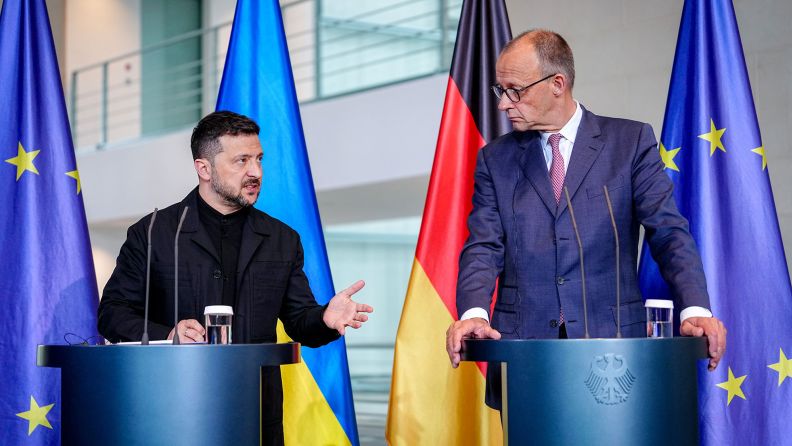
In a significant step to bolster Ukraine’s defense capabilities, Germany has agreed to jointly produce long-range missiles with Ukraine. This collaboration aims to equip Kyiv with weapons capable of striking deep behind Russian lines, a capability Ukraine has notably lacked since the conflict began. The announcement came from German Chancellor Friedrich Merz after a high-level meeting with Ukrainian President Volodymyr Zelenskiy in Berlin.
A New Chapter in Germany-Ukraine Defense Cooperation
During their meeting, Chancellor Merz emphasized the strategic importance of enhancing Ukraine’s missile capabilities. Both nations plan to sign a memorandum of understanding, which will formalize the joint production of long-range missiles. Merz highlighted that this cooperation will extend to the industrial sector, with manufacturing potentially taking place both in Ukraine and Germany.
“We want to make long-range weapons possible. We also want to make joint production possible,” Merz stated, signaling Germany’s commitment to supporting Ukraine’s defense infrastructure not just through supplies but through shared production.
Why Long-Range Missiles Matter
Since the conflict between Ukraine and Russia escalated more than three years ago, Ukraine has struggled with a critical gap in its military arsenal: the ability to launch missiles capable of hitting targets deep inside Russian territory, far beyond the immediate front lines.
Long-range missiles are crucial because they allow Ukraine to disrupt Russian military logistics, supply routes, and command centers, which are often located well behind the front. Without such capabilities, Ukraine’s strategic options have been limited, forcing reliance on short-range weapons and allied supplies.
Existing Support from Allies and Its Limitations
The United Kingdom and France have supplied Ukraine with Storm Shadow/Scalp cruise missiles, while the United States later provided ATACMS ballistic missiles. However, the numbers of these advanced weapons have been limited, and restrictions on their use were initially stringent.
Though some of these restrictions have since eased, Ukraine remains in need of greater quantities and a more sustainable way to maintain and expand its missile arsenal. This necessity has driven Kyiv to seek partnerships that can help build domestic missile production capacities.
Germany’s Strategic Role and Message to Russia
Chancellor Merz also issued a clear message to Russia: the refusal to engage in peace talks and to honor ceasefires will have tangible consequences. By supporting Ukraine’s ability to defend itself more effectively, Germany is signaling a firmer stance against Russian aggression.
“This cooperation marks a decisive shift,” Merz said. “You can assume that the Russian side’s refusal to conduct talks, its refusal to observe a ceasefire, will now have real consequences.”
The Industrial Dimension: Building Ukraine’s Defense Future
The planned joint production will not only supply Ukraine with immediate military hardware but also aim to strengthen Ukraine’s defense industry. Manufacturing cooperation between the two countries could enhance Ukraine’s long-term ability to produce sophisticated weapons independently.
This industrial partnership represents a strategic investment in Ukraine’s sovereignty and resilience, potentially allowing it to maintain and upgrade its defense capabilities beyond the current conflict.
What This Means for the Conflict and Beyond
The joint missile production agreement is a landmark development in the Ukraine-Russia conflict. It could shift the military balance by providing Kyiv with the tools needed to target high-value Russian assets more effectively.
For Germany, the move reflects a growing willingness to play a direct role in supporting Ukraine beyond diplomatic and humanitarian aid. It also underscores the European commitment to countering Russian aggression.
Strengthening Ties Amid Turbulence
Germany’s cooperation with Ukraine on missile production marks a new phase in their partnership, blending political support with tangible military collaboration. As the conflict continues to challenge Ukraine’s survival, this joint effort represents hope for greater self-reliance and enhanced defense capabilities.
Both Berlin and Kyiv are sending a clear message: the refusal to pursue peace will be met with increased resistance, and Ukraine will be empowered to defend its sovereignty with advanced, long-range weaponry.

