
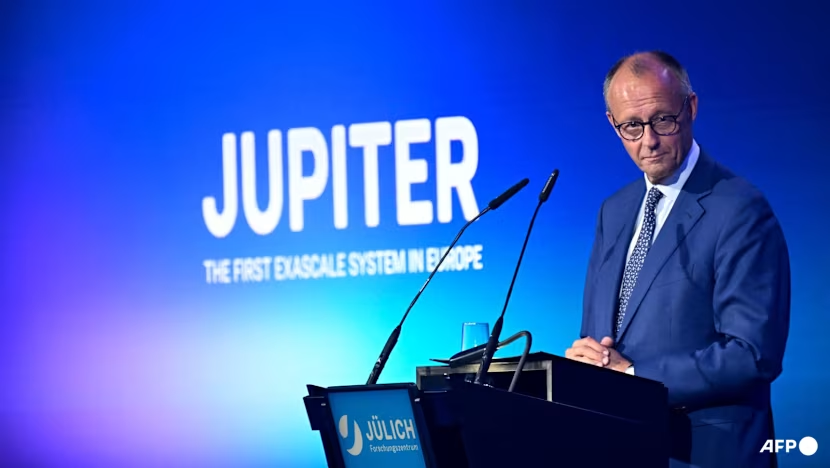
Germany Launches World’s Fourth-Fastest AI Supercomputer to Compete with US and China

Germany’s New AI Powerhouse Unveiled by Chancellor Merz
Germany’s Chancellor Friedrich Merz inaugurated a groundbreaking supercomputer powered by Nvidia chips on Friday, marking a major milestone in Europe’s race for artificial intelligence (AI) supremacy. The system, now ranked as the fourth-fastest supercomputer in the world, aims to boost Europe’s research capabilities and help it compete with global leaders like the United States and China.
AI Innovation at the Heart of Europe’s Strategy
Speaking at the launch event, Chancellor Merz emphasized the importance of cutting-edge technology in securing Europe’s future. “This supercomputer is a key step toward catching up with the world’s AI front-runners,” he said, highlighting Germany’s commitment to fostering innovation and scientific advancement.
The machine will support complex AI research, data analysis, and high-performance computing applications, enabling breakthroughs in sectors such as healthcare, climate science, and engineering.
Nvidia Technology Drives Next-Generation Computing
The supercomputer relies on Nvidia’s advanced graphics processing units (GPUs), known for their power and efficiency in handling AI workloads. These chips are central to accelerating computations that are critical in deep learning, simulations, and large-scale data processing.
By harnessing Nvidia’s technology, the new system places Europe in a stronger position to contribute to global AI development, which is increasingly shaping economic and geopolitical landscapes.
Strengthening Europe’s Role in Global AI Research
While the United States and China currently lead the AI race, Europe’s investment signals its determination not to be left behind. Researchers believe that having faster, more powerful computing infrastructure will enable European scientists and engineers to tackle some of the most complex challenges, from medical research to renewable energy.
The supercomputer also offers new opportunities for collaboration across universities, research institutes, and industries, fostering innovation and driving scientific discovery.
Economic and Strategic Implications
Beyond research, this development reinforces Europe’s strategic autonomy in technology. By investing in advanced computing infrastructure, Germany and its partners aim to reduce reliance on external providers and build a robust AI ecosystem within Europe.
Experts also predict that such investments will attract talent, support startups, and create new markets, helping the continent stay competitive in a rapidly evolving digital world.
Looking Ahead
The inauguration of this AI supercomputer represents a turning point for Europe’s technology ambitions. With this powerful new tool, German researchers and their counterparts across the continent are set to make significant contributions to science, medicine, and industry.
As competition intensifies among global powers, Germany’s leadership in AI research demonstrates its resolve to secure Europe’s place at the forefront of technological progress.

