
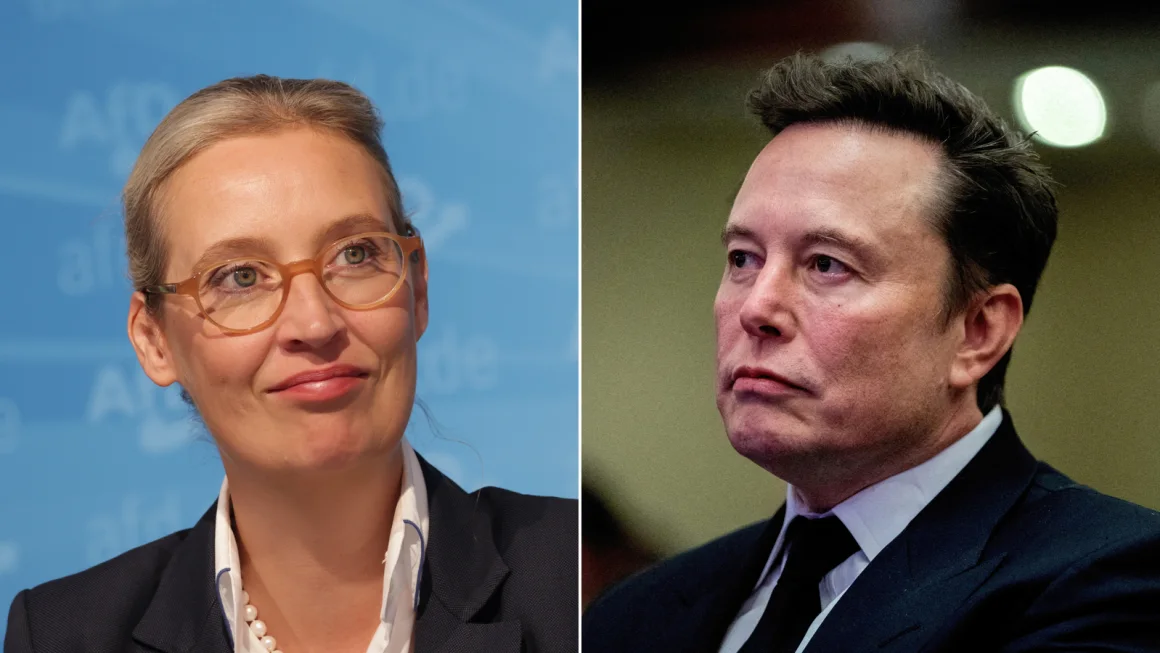
Elon Musk Urges Germans to Vote for Far-Right AfD: What This Means for Germany’s Election

Elon Musk Joins Political Debate: Why He’s Backing AfD in Germany
Elon Musk is no stranger to controversy, but his recent comments on German politics have raised eyebrows. The tech billionaire, known for his roles at Tesla, SpaceX, and Twitter, has waded into European politics by urging Germans to vote for the far-right party Alternative for Germany (AfD) in the upcoming elections.
In a livestream on the social media platform X (formerly Twitter), Musk praised the AfD co-leader, Alice Weidel, as “very reasonable” and claimed that the party is the only solution to Germany’s problems. Musk’s involvement in European politics has sparked debates across the continent, especially in Germany, where his comments have garnered significant attention.
Musk’s Bold Statement on Germany’s Future
During the livestream with Alice Weidel, Musk boldly declared, “Only AfD can save Germany, end of story,” while urging the German public to support the party in the country’s election on February 23. His reasoning? Musk believes that if people don’t vote for change, things will get worse in Germany.
He also compared the situation in Germany to the U.S., where voters turned to Donald Trump in 2016 because they were dissatisfied with the status quo. Musk’s suggestion that AfD is Germany’s version of Trump’s movement is a strong endorsement for a party that has been a vocal critic of the establishment.
AfD: A Party with Controversial Views
AfD, founded in 2013, is Germany’s far-right political party known for its strong anti-immigration stance and opposition to the European Union. It has gained popularity by appealing to voters frustrated with mainstream politics, much like other far-right movements across Europe.
In their conversation, Weidel shared her views on Germany’s role in international affairs, including Russia’s war in Ukraine. She claimed that Europe is too dependent on the U.S. to handle the conflict and that it is dangerous for Europeans to escalate the situation without taking more responsibility themselves. She also expressed her belief that AfD is the only party in Germany that can protect Jewish communities from what she described as “Muslim crime.”
What’s at Stake in the Upcoming German Election?
Germany’s upcoming election is a big moment for the country, especially with the political climate shifting. The country has been led by Chancellor Olaf Scholz and his Social Democratic Party (SPD) since 2021, but recent turmoil, including the collapse of the government, has left many voters feeling dissatisfied.
AfD is expected to come in second behind the center-right Christian Democratic Union (CDU), the party of former Chancellor Angela Merkel. Many believe that AfD’s rise in the polls is a direct result of dissatisfaction with Scholz’s government, and Musk is tapping into that discontent. However, while AfD is gaining traction, its controversial policies have led to significant criticism from mainstream German political figures.
Musk’s Relationship with AfD: A Growing Alliance
Musk’s connection with Alice Weidel and the AfD is not new. The two have been in contact for months, and Musk has repeatedly voiced his support for the party.
In December, Musk tweeted, “Only the AfD can save Germany,” following the collapse of the German government. Weidel responded positively, agreeing with Musk’s assertion. This public support has caused a stir among German politicians, who have accused Musk of interfering in their political process.
Musk also didn’t hold back when commenting on German President Frank-Walter Steinmeier. He labeled him an “anti-democratic tyrant” after the president spoke out against foreign interference in Germany’s political affairs.
Mainstream German Politicians React to Musk’s Support for AfD
Germany’s mainstream political leaders have not been pleased with Musk’s public endorsement of AfD. Lars Klingbeil, co-leader of the SPD, has drawn comparisons between Musk and Russian President Vladimir Putin, criticizing the billionaire for meddling in German politics.
Chancellor Scholz also voiced his disapproval, stating in his New Year’s address that decisions about Germany’s future should be made by its citizens, not by the owners of social media platforms like Musk. Scholz’s comments reflect the growing unease among politicians about Musk’s influence in Europe, especially given his involvement with far-right parties.
Why Does Musk Support AfD?
Musk’s support for AfD aligns with his broader political leanings and his history of backing controversial figures. As a close ally of Donald Trump, Musk seems to have a deep interest in supporting movements that challenge the political establishment, both in the U.S. and abroad. By backing AfD, Musk is reinforcing his commitment to supporting far-right politics and populist movements across the globe.
Musk has repeatedly voiced his dissatisfaction with mainstream political parties and what he sees as their failures. By endorsing AfD, he is signaling his belief that the party represents a way forward for Germany, even if it’s through controversial and radical means.
The Global Impact of Musk’s Political Influence
Musk’s growing involvement in European politics is not without consequences. His political actions have already triggered backlash in countries like the UK and Germany, where leaders are concerned about the influence of Silicon Valley billionaires on national elections.
In the U.S., Musk’s close ties to Trump and his outspoken political views have made him a polarizing figure. Now, with his public endorsement of AfD, Musk is broadening his reach, aligning himself with far-right political movements in Europe as well.
This raises an important question: What does Musk’s growing involvement in international politics mean for the future of democratic processes? Will tech moguls like him continue to exert their influence over political landscapes, or will their power be checked by public backlash?
Conclusion: A Divisive Influence in European Politics
Elon Musk’s involvement in Germany’s upcoming election has made waves across Europe, with his public support for the far-right AfD party raising concerns among mainstream political leaders. While Musk believes that AfD is the solution to Germany’s political and economic struggles, his comments have sparked heated debates about the role of tech billionaires in shaping political outcomes.
As Germany prepares for its election on February 23, all eyes will be on how the far-right party fares at the polls and whether Musk’s endorsement plays a role in influencing the outcome. One thing is clear: Musk’s political influence is growing, and his support for AfD could have far-reaching consequences for Germany and beyond.

