
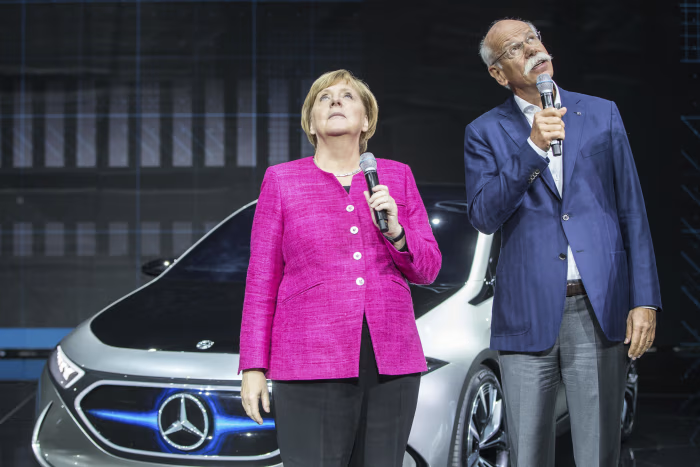

Automotive CEOs across Germany are intensifying efforts to optimise electric vehicle (EV) costs as the industry navigates rising competition, fluctuating demand, and persistent margin pressure. With the transition to electric mobility now firmly underway, German automakers are shifting focus from early-stage innovation to large-scale efficiency, aiming to make EVs more affordable while protecting long-term profitability.
A central priority for automotive leaders is battery cost reduction, which remains the single largest expense in EV manufacturing. CEOs are pushing for deeper vertical integration, long-term supplier contracts, and in-house battery cell production to reduce dependency on volatile global supply chains. Several manufacturers are also redesigning battery packs to use fewer rare materials, lowering exposure to commodity price swings while maintaining performance standards.
At the same time, German automotive CEOs are streamlining vehicle platforms and model portfolios. Instead of developing multiple bespoke architectures, companies are consolidating production around modular EV platforms that can support a wide range of models—from compact city cars to premium sedans and SUVs. This approach allows manufacturers to spread development costs over higher volumes, reduce engineering complexity, and accelerate time-to-market.
Manufacturing efficiency has emerged as another major lever. CEOs are accelerating investments in automation, robotics, and AI-driven production systems to improve throughput and reduce labour costs per vehicle. Smart factories with predictive maintenance, real-time quality monitoring, and digital twins are increasingly seen as essential tools to manage EV complexity while maintaining Germany’s reputation for engineering excellence.
Automotive leaders are also rethinking supply chain strategies in response to geopolitical uncertainty and logistics disruptions. Many CEOs are advocating for nearshoring and regional sourcing of key components, including semiconductors and power electronics. While local sourcing may appear costlier initially, executives argue that it reduces long-term risks, stabilises production schedules, and ultimately lowers total cost of ownership.
Pricing strategy is another area undergoing transformation. German automotive CEOs are moving away from aggressive early-adopter pricing models toward more disciplined approaches that balance volume growth with sustainable margins. Several manufacturers are introducing entry-level EV variants with simplified features, targeting cost-conscious consumers without diluting brand value. Software-based upgrades and digital services are increasingly used to create new revenue streams post-sale, helping offset lower hardware margins.
Energy costs, particularly in Germany, remain a critical challenge. In response, automotive CEOs are investing heavily in renewable energy sourcing and energy-efficient plants. By powering factories with solar, wind, and long-term green energy contracts, manufacturers aim to reduce operating expenses while aligning with climate commitments. Executives believe that energy optimisation will play a decisive role in keeping German EV production competitive against lower-cost manufacturing regions.
Collaboration is also gaining momentum. CEOs are exploring strategic partnerships with technology firms, battery specialists, and even competitors to share development costs and accelerate innovation. Joint ventures for battery plants, charging infrastructure, and software platforms are increasingly viewed as pragmatic solutions in a capital-intensive transition phase.
Despite these cost optimisation efforts, German automotive leaders remain cautious about market conditions. Slower EV adoption in some European markets, reduced government subsidies, and price competition from international players continue to weigh on outlooks. As a result, CEOs are emphasising flexibility—designing production systems that can adjust output quickly and maintaining hybrid line-ups to hedge against demand volatility.
Looking ahead, automotive CEOs in Germany see cost optimisation not as a short-term response but as a structural shift. The next phase of EV growth, they argue, will be defined less by breakthrough technology and more by execution excellence—efficient factories, resilient supply chains, disciplined pricing, and scalable platforms. Those manufacturers that master these fundamentals are expected to emerge stronger, more competitive, and better positioned to lead the global electric mobility market.
As the EV race intensifies, German automotive CEOs are betting that rigorous cost discipline combined with engineering leadership will allow them to defend their global standing while making electric mobility accessible to a broader consumer base.

