
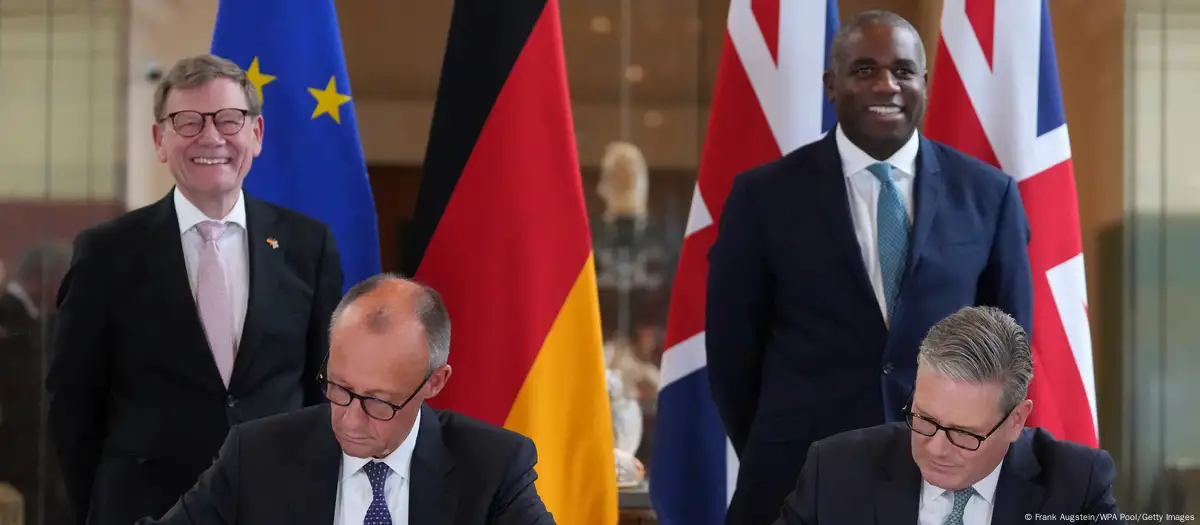

A New Era Begins: Germany and Britain Reaffirm Ties with Landmark Treaty
In a powerful symbol of reconciliation, diplomacy, and shared future ambitions, Germany and the United Kingdom have signed a historic friendship treaty designed to reset their relationship in the wake of Brexit. The agreement, finalized in London on Thursday, comes nearly a decade after the UK voted to leave the European Union and 80 years after the end of World War II — marking a significant moment in European political history.
British Prime Minister Keir Starmer and German Chancellor Friedrich Merz sealed the treaty in a meeting marked by both ceremony and pragmatism. While the agreement was largely negotiated under the previous German government, its finalization under the new leadership underscores a renewed commitment to strengthening bilateral cooperation beyond the European Union framework.
What the Friendship Treaty Covers
This treaty is more than a symbolic gesture. It aims to deepen collaboration in several key areas that have experienced strain or ambiguity since Brexit. Key elements include:
- Enhanced Security and Defense Cooperation: The UK and Germany pledge to increase intelligence sharing, joint military training, and participation in NATO-related initiatives.
- Economic and Trade Dialogue: While the UK is no longer part of the EU single market, both nations are committed to reducing trade barriers where possible, supporting mutual investment, and addressing post-Brexit regulatory friction.
- Climate and Energy Partnership: The agreement highlights joint commitments to net-zero goals, renewable energy research, and cross-border energy infrastructure development.
- Science, Education, and Innovation: The treaty reinstates and expands academic partnerships, encourages student exchanges, and promotes joint funding for scientific research.
- Cultural Ties and Civil Society: It includes plans to revive cultural cooperation, museum and gallery partnerships, and language programs to keep younger generations connected across borders.
“This Is About Looking Forward” — Leaders’ Remarks
Speaking from London, Prime Minister Keir Starmer described the moment as “an opportunity to turn the page” on years of political instability and diplomatic coolness following the Brexit vote.
“This treaty is not just about repairing what was lost — it’s about building something new,” Starmer said. “Germany is one of our closest allies in Europe, and this agreement lays a modern foundation for mutual progress.”
Chancellor Friedrich Merz echoed this sentiment, stating that the two nations “share more than just a complex history — we share values, challenges, and a responsibility to uphold peace and prosperity in Europe.”
“It’s time to focus on what unites us,” Merz said. “And that is a common desire for democracy, economic stability, and a sustainable future.”
Historical Weight: 80 Years After WWII
The timing of the treaty holds profound symbolic importance. Signed 80 years after the end of World War II, the agreement serves as a reminder of how far Anglo-German relations have come.
From wartime enemies to NATO allies and key trading partners, the relationship has matured into one of strategic partnership. While Brexit introduced fresh complications, the treaty aims to preserve and strengthen that legacy in a new geopolitical context.
Post-Brexit Context: A Need for Reset
Since the UK officially left the European Union in January 2020, relations with major EU countries, including Germany, have faced significant challenges. Issues ranging from customs delays to regulatory divergence have strained previously seamless cooperation.
Germany, as Europe’s largest economy and a key political force in Brussels, had taken a cautious stance during Brexit negotiations. However, in the years since, both nations have recognized the long-term importance of maintaining a strong bilateral relationship outside the EU framework.
The treaty reflects a shift in tone from friction to functionality.
Defense and Security: A Shared Priority
One of the most urgent areas of alignment is defense. With Russia’s war in Ukraine continuing and global tensions on the rise, both the UK and Germany are seeking to solidify NATO’s eastern flank and invest in joint military readiness.
The treaty establishes regular bilateral security dialogues and increased interoperability between armed forces. It also signals Britain’s intention to remain deeply involved in European security despite its formal exit from EU defense structures.
Trade and Economy: Stabilizing Uncertain Ground
Trade between the UK and Germany, while still substantial, has declined in volume and efficiency since Brexit due to customs checks, divergent regulations, and tariffs. The treaty doesn’t rewrite trade laws — that remains under the broader UK-EU Trade and Cooperation Agreement — but it does create mechanisms for smoother dialogue and resolution of disputes.
Germany is the UK’s second-largest trading partner, and British exports to Germany include pharmaceuticals, machinery, and vehicles, while German imports to Britain include cars, electronics, and industrial equipment.
The treaty includes a provision to set up a bilateral economic council, aiming to identify investment opportunities and technological partnerships in sectors like AI, green energy, and advanced manufacturing.
Climate and Science: A Unified Future
With climate change being a global challenge, the treaty outlines shared ambitions for achieving net-zero emissions and investing in sustainable technologies. There’s an emphasis on electric vehicle development, offshore wind farms, and green hydrogen production.
On the academic front, it revives many of the collaborative efforts that stalled post-Brexit. German and British universities are expected to resume joint research programs, and more funding will be made available for student mobility — addressing the loss of Erasmus+ program access after Brexit.
A Model for Future Bilateral Treaties?
While not a substitute for EU membership, the UK-Germany treaty may serve as a model for how Britain can build strong bilateral partnerships with key European nations. It highlights a potential path for post-Brexit Britain: working around Brussels through strategic, country-to-country diplomacy.
Other countries, such as France and the Netherlands, may soon explore similar frameworks if the German treaty proves successful in smoothing over disruptions and delivering tangible benefits.
Final Thoughts
The UK-Germany Friendship Treaty marks a new chapter in one of Europe’s most important bilateral relationships. While it does not reverse Brexit, it goes a long way in repairing the practical and diplomatic cracks it left behind.
As the world faces shared threats—from war to climate change—this treaty is a reminder that cooperation, not isolation, is the key to progress.

