
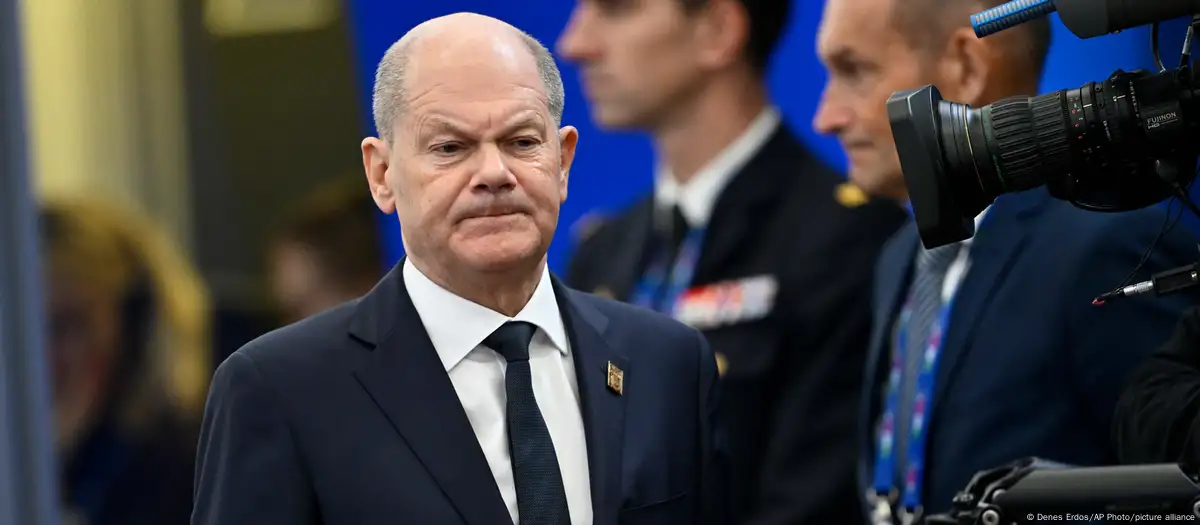
Why German Chancellor Olaf Scholz Became So Unpopular – And What’s Next for His Political Future

German Chancellor Olaf Scholz has been grappling with unimpressive approval ratings, but despite this, he remains determined to run again in the 2025 federal election as the top candidate for his Social Democratic Party (SPD). His tenure has been marked by a series of crises, internal conflicts, and challenges that have led to his government becoming one of the least popular in postwar history. But why exactly has Scholz’s popularity tanked, and what does his political future look like?
Olaf Scholz’s Struggles in Power
In September 2024, when asked about how he hoped history would view his time as Chancellor, Scholz shrugged off the question, suggesting that politicians shouldn’t be concerned with their legacy before they’ve finished their term. Yet, two months later, as his three-party coalition collapsed, the question of his legacy became unavoidable.
While Scholz remains the SPD’s candidate for the upcoming election in February 2025, his popularity is at an all-time low. And with Boris Pistorius, the 64-year-old Defense Minister, topping the popularity charts, many within the SPD have started questioning whether Scholz should remain their leader. Pistorius, praised for his leadership during tough times, has been Germany’s most popular politician for months, making him a strong contender for the role of Chancellor.
The Worst Approval Ratings in German History
If Scholz fails to secure a second term, he will go down in history as having one of the shortest chancellorships in postwar Germany. The Christian Democratic Union (CDU) and its Bavarian sister party, the Christian Social Union (CSU), are expected to claim the chancellorship, marking a disastrous end to Scholz’s reign. This has been a long time coming, as his government has seen a series of missteps and faltering support from the public.
Critics have been especially vocal about Scholz’s failure to effectively handle several crises that have unfolded under his leadership, from Russia’s invasion of Ukraine to the energy crisis that followed. Despite these challenges, Scholz remains stubbornly confident, often projecting an air of control even when faced with severe issues. But is this self-assuredness clouding his ability to understand the realities of the country?
Scholz’s Dismissive Attitude Towards Public Concerns
In one instance, after his coalition government collapsed, Scholz gave an upbeat speech in parliament, a move that angered many, including CDU leader Friedrich Merz, who blasted him for being out of touch. Merz remarked, “You obviously live in your own cosmos, in your own world,” accusing Scholz of failing to understand the deep frustrations of the public. This sense of detachment from the concerns of ordinary Germans has contributed to Scholz’s growing unpopularity.
Despite all these challenges, Scholz continues to hold on to his belief that he is the right person to lead Germany through its current difficulties. But his confidence has increasingly been seen as a flawed perception of reality, further distancing him from those who are struggling under the weight of the crises his government has been unable to resolve.
The Crises That Shaped Scholz’s Chancellorship
Scholz became Chancellor in 2021, taking over from Angela Merkel after her 16-year tenure. But from the outset, his leadership has been marred by a series of complex issues that have tested his resolve. Here are some of the key crises that have shaped his time in office:
1. Russia’s Invasion of Ukraine
Perhaps the biggest challenge of Scholz’s time as Chancellor has been Germany’s response to Russia’s invasion of Ukraine. Germany, heavily reliant on Russian energy supplies, faced a dilemma: how to support Ukraine militarily while avoiding direct involvement in the conflict. Scholz was criticized for not taking a stronger stand earlier on, particularly in the matter of military support to Ukraine, and the country’s energy crisis made the situation even more precarious.
2. The Energy Crisis
The war in Ukraine sent energy prices skyrocketing, and Scholz’s government struggled to find ways to protect German consumers and businesses from sky-high energy bills. The country’s dependence on Russian gas, along with the need to transition to greener energy sources, created a perfect storm that hit German households and businesses hard.
3. Economic Downturn
The energy crisis compounded existing economic problems, with inflation and a slumping economy dampening consumer confidence. Scholz’s government faced intense pressure to support businesses and workers affected by the crisis, but many believed the response was slow and ineffective.
4. Rising Far-Right Influence
Another troubling issue during Scholz’s time in office has been the rise of far-right political groups. As economic uncertainty and immigration debates intensified, the far-right gained more ground in elections, causing concern about the growing polarization in German politics. Scholz’s SPD, once a powerful political force, found it increasingly difficult to counter the appeal of extremist movements.
The Fallout: Scholz’s Approval Rating Hits Rock Bottom
Throughout all of these crises, Scholz’s approval rating has dropped to its lowest point. His handling of these key issues — particularly the energy crisis and his response to the Ukraine war — has left many Germans feeling disillusioned.
Recent polls show that Scholz’s SPD is trailing far behind the CDU/CSU, signaling a major shift in public opinion. Voters seem to have lost faith in his leadership, and many see his government as ineffective and out of touch with the struggles faced by ordinary people.
This discontent has led some within his own party to suggest replacing him with more popular figures like Boris Pistorius, whose approval rating has surged due to his calm leadership in the face of adversity.
Scholz’s Determined Bid for Re-Election
Despite the overwhelming challenges and his low approval ratings, Olaf Scholz remains determined to lead Germany into the 2025 election. His belief in his own abilities has always been a central part of his persona, and he is not one to back down easily. However, his political future is looking increasingly uncertain, and many are questioning whether his leadership is what Germany needs to navigate the crises ahead.
As the election approaches, Scholz’s legacy will be on the line. If he can turn things around and gain back the trust of the German public, he could secure a second term. But if the CDU/CSU takes over, his time as Chancellor could be marked as a brief and tumultuous period in German politics.
Conclusion: Can Scholz Make a Comeback?
Olaf Scholz’s political career has been a rollercoaster ride, and as he faces difficult elections in 2025, the question remains: Can he bounce back from his dwindling popularity and secure another term? Or will Germany turn to new leadership?
The road to 2025 looks difficult for Scholz, with his government grappling with multiple crises and his approval ratings at an all-time low. While his self-confidence and determination are admirable, they may not be enough to restore faith in his leadership. The future of German politics will depend on whether the voters can see beyond the challenges of the past and trust Scholz to lead the country through uncertain times.

